Exhibitions

THE ART OF PERFECTION
—
ISABELLA LEPOAMO
—
Isabella Lepoamo explores the emotional framework of competition, performance, and perfectionism, drawn from her history as a professional synchronized swimmer representing New Zealand. Through self-portrait rhinestone and stainless-steel sculptures, the works examine beauty, endurance, labour, and self-image, reflecting on the pressures of perfection and visibility. The exhibition also considers the competitive environment and how systems of comparison, achievement, and recognition continue to shape artistic identity and self-worth.

SMALL WORLD
—
PON HUEY MIN, PETER SIMPSON, MELODY RENAUD
—
In Aotearoa, insects represent the vast majority of our animal diversity, yet they often go unnoticed. Small World is an interactive digital installation that invites audiences to draw their own bugs and release them into an evolving ecosystem.
This work celebrates creativity and quiet observation. By participating and viewing these digital creations, the audience is invited to slow down, reflect, and find empathy for the small lives that sustain our world.
FROM THE ARBORIST TO THE BUILDER
—
BENJAMIN EVERITT, KYOTO TIMBER FRAMES & ASIA KIWI ARCHITECTS
—
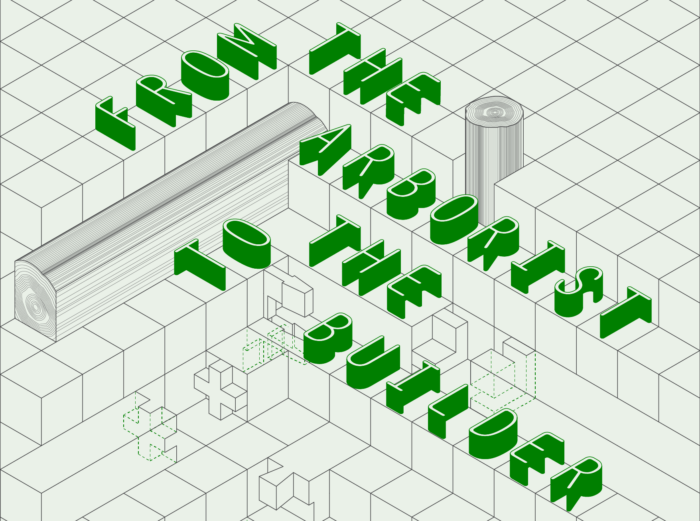
From the forest floor to the floors of our homes, how does the journey of a single tree shape the future of New Zealand housing?
In Aotearoa, the story of timber is often reduced to a single species: Radiata Pine. Through photos, infographics, models, and diagrams, From the Arborist to the Builder asks us to reconsider the way we grow, manufacture, and build using one of our most vital resources. Looking beyond timber as a mere resource and instead seeing it as part of a larger, living network.

I Will Be A Feast For All That Hums
—
Witching Hour
—
Whai mai ki Te-Aitanga-a-Pepeke, te ao o Whiro-te-tipua. I will be a feast for all that hums is presented by Witching Hour, a collective of four Elam-educated artists; Madison Carroll, Meiya Julian-Takahashi, Angus Edwards, and Elise Sadlier. A feast for all is centred around Whiro, the Māori Atua associated with insects, darkness, decay, and transformation. The installation ushers viewers into the microscopic world, bringing to life a giant pūriri moth caught in a web. Large scale paintings explore entomology amid a garden of concrete and ceramic forms.

Cementing Destruction
—
Linda Jarrett
—
This exhibition explores the hidden environmental impact of concrete through analogue photography and experimental photographic processes. By using concrete dust, limestone and wet concrete to create the prints, the material becomes part of the artwork itself. The resulting images encourage viewers to look beyond concrete’s everyday presence and consider its role in shaping landscapes, communities and the environment, revealing both its creative potential and its destructive consequences.

Coexisting Reflections
—
Kate Bedford
—
Coexisting Reflections brings together a series of abstract collage works and mixed-media paintings exploring the natural world. The exhibition celebrates the meeting of different materials and processes, exploring the ways they reflect, absorb, and respond to light. Floral forms unfold among planetary spheres, where opposites meet and coexist. Bright, luminous passages sit alongside the quiet mystery of matte surfaces. While calm, still spaces are punctuated by vibrant bursts of colour.
Stray Thoughts
—
Linley Wilkinson
—
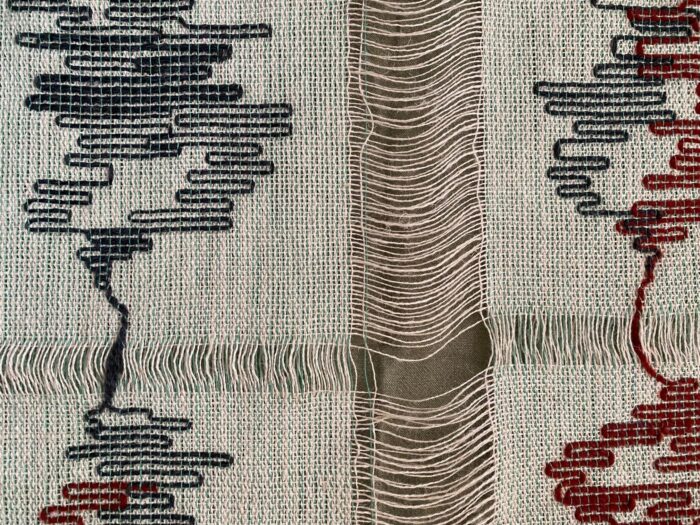
Stray Thoughts illustrates our connecting thoughts, dreams and memories as we journey through life. Linley Wilkinson uses hemp woven with a wool overlay to explore how these connections do not always take a straight path, instead becoming a tangled mass that forms
our present identity and what we may become. When viewed closely, we can see that this tangled mass is a sophisticated arrangement of lines and spaces, nature working at its best inside us all.

Taking Shape
—
Nina Bulgakova
—
In this new body of work, Nina Bulgakova explores how personal boundaries shift through the process of adaptation. The works combine sand-textured reliefs with paint, built up in layers over time. The flowing, shifting forms become a metaphor for adapting to a new environment, while the sand offers a way of grounding through material, acting as a physical anchor amid change. The meditative nature of the process is reflected in the resulting forms: quiet, layered, changing, and reaching for balance.

Woven Spaces
—
Kelly Thompson
—
Woven Spaces explores patterns of rhythm and light. Using hand and loom structures, Kelly Thompson weaves together plant fibres and yarns, creating formal and informal grid structures of varying textures, densities, methods, and materials. Each work experiments with contrast; playing with irregularity, disrupting and maintaining borders, and the relationship between transparency and materiality. The works become material drawings in space.

Tātai Hono - Connection Through Stories
—
Ōwairaka Community Club
—
Ōwairaka Community Club are a community who come together in Mt Albert for social connection, and to explore their own creativity through art. Members work both individually and collectively to enhance and maintain well-being. The artworks reflect members of the Club’s recent explorations; each person discovering and developing processes that are meaningful to them and in doing so evolving their own style. The exhibition showcases the diversity of artworks and approaches created by Ōwairaka Community Club.

Student Show
—
Ceramics Drop-In
—
Studio One Toi Tū is thrilled to present works by regular artists and makers from the 'Drop-In' Ceramics Studio. This exhibition showcases diverse and creative projects made in a self-guided space, where participants access specialist facilities and work independently.
The group show features a lineup of regular attendees of emerging and established artists from the vibrant ceramics community. The works range from smooth, flowing forms to intricate, textured surfaces, the artists have pushed the boundaries of traditional ceramics by experimenting with innovative techniques and unique approaches. Each piece tells a story of exploration and creativity, showcasing the dynamic relationship between the artist and the medium.

Student Show
—
Teen Artwork
—
In this annual exhibition Studio One Toi Tū is delighted to present the works of participants from the long-standing Teen Art course. This unique programme offers a dynamic multimedia art-making environment where young artists can thrive. Each year, the group spends one term fully immersed in ceramic making. With dedicated time to explore and create, students are encouraged to immerse themselves in their creative processes while developing ideas and skills in a supportive setting. The exhibition celebrates the Teen Art group's time in the sculpture studio and highlights their finished pieces alongside the distinctive processes and experimental approaches explored through this versatile medium.